AI coding that runs
on your machine.
orangu is an open-source AI coding environment for the terminal that reads your project, edits your files, reviews your branch, and runs your whole Git workflow — with its own pure-Rust inference server underneath. No API keys, no telemetry, no data leaves your machine.
The private,
Git-centric companion.
orangu is the lean, private, Git-centric coding companion for the terminal — built for developers who run their own models and want a tightly integrated review workflow without sending a single line of code to the cloud.
100% local and private
Zero telemetry. After the model is downloaded, no internet is needed — it runs happily in air-gapped environments.
Built-in code review
An interactive two-pane reviewer (/review) and a category-by-category LLM auto-reviewer (/auto_review). orangu's standout feature.
The whole Git loop in the prompt
Branch, commit, rebase, squash, cherry-pick, stash, push, and GitHub/GitLab PRs, comments, and issues — all from the terminal.
Pure Rust, top to bottom
Quick startup, no runtime to install, its all Rust based.
Three cooperating programs,
one Pure-Rust project.
orangu is a complete, self-contained AI coding stack — not just a client. Every layer is open source under GPL v3, and there is no proprietary backend to call home to. Two further binaries ship in the same archive: the benchmarking tool orangu-bench, and orangu-gguf, which builds the model files the rest of the stack runs on.
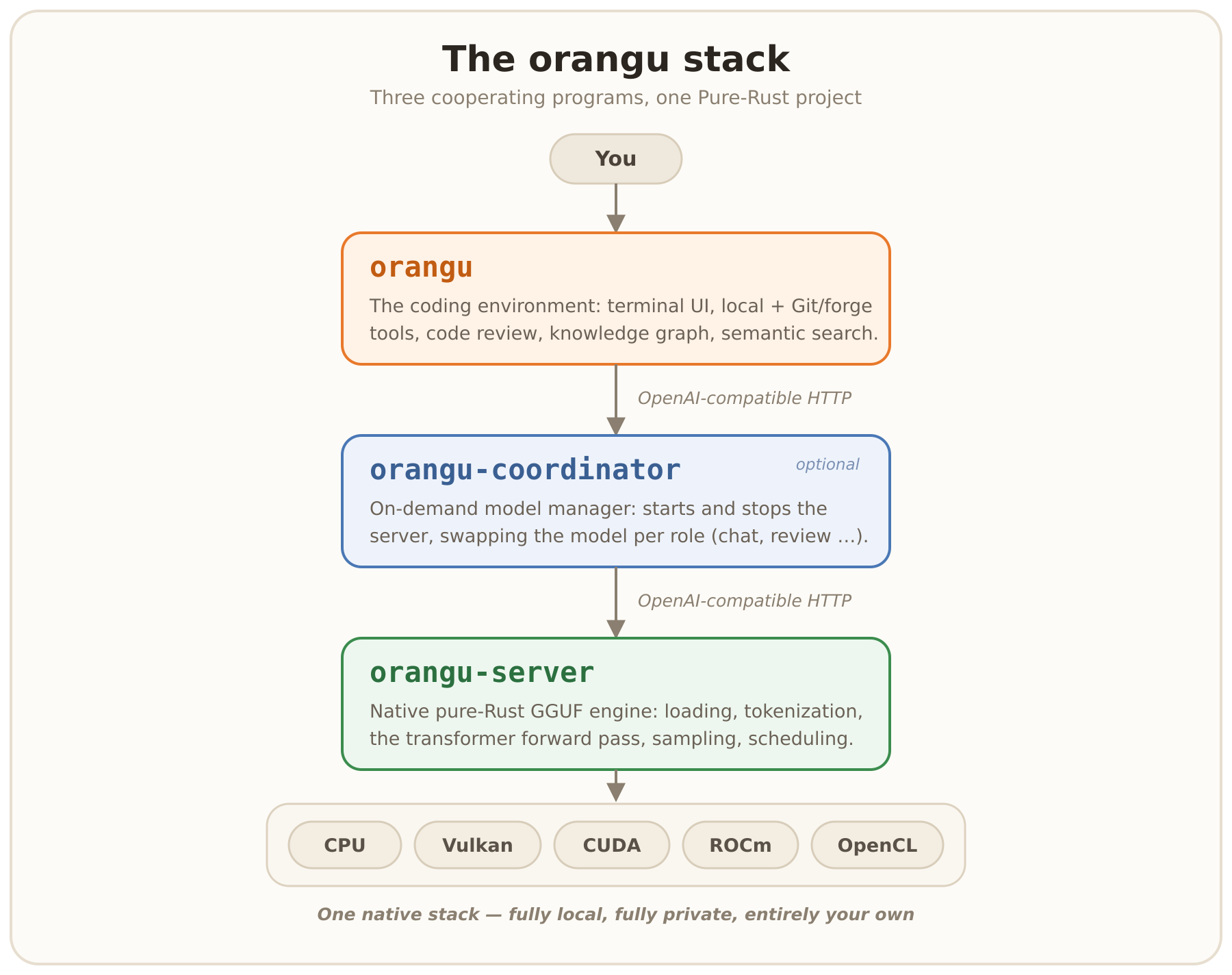
-
orangu
The coding environment: terminal UI, workspace-aware local tools, the full Git and GitHub/GitLab loop, code review, knowledge graph, and semantic search.
-
orangu-coordinator Optional
An on-demand model manager. It starts and stops the server for you and swaps to whichever model each role needs — chat, review, and the rest — so a single-GPU machine never has to run several servers at once.
-
orangu-server
A native pure-Rust GGUF inference engine: model loading, tokenization, the transformer forward pass, sampling, and request scheduling — with no llama.cpp, no ggml, and no Python. It serves OpenAI-compatible endpoints and a built-in web console.
CPUVulkanMetalCUDAROCmOpenCLNPU -
orangu-bench Tool
A benchmarking tool rather than part of the stack. It measures decode and prefill throughput of any OpenAI-compatible server over HTTP and charts it over time, so a backend change or a new quantization can be judged on your own hardware instead of someone else's numbers. Runs from the command line or the web console.
-
orangu-gguf Tool
The model builder, new in 1.3.0. It pretrains a model from scratch out of a manifest of permissively-licensed repositories — cloning them, training a tokenizer, packing the text into tokens, and writing the result as a GGUF file
orangu-serverloads directly — and it rewrites an existing model at a smaller weight format, fromq6_kdown toq2_k.
Your terminal is now a
code-review workstation.
This is orangu's standout feature. Review the changes on your branch — committed and uncommitted, measured against the merge base with your default branch — two ways: an interactive reviewer you drive, and a fully automated one the model runs end to end. Both require an up-to-date rebase, so you never review against stale code.
Interactive review
- Full-screen two-pane view — file checklist beside the selected file's diff
- Mark each file approved or rejected; comment on any line under seven categories
- Ask the model about a file on demand — the exchange joins your chat session
- Open any file in
$EDITORwithout leaving the view - Exit writes a category-grouped report with an approve/reject conclusion, copied to your clipboard. No
gh/glabneeded
LLM-driven review
- The model reviews the whole change and each file on its own, sorting findings into seven categories
- Renders a final orangu approves / rejects this patch verdict
- Smart about effort — lock files and binaries auto-approve, docs get doc checks, source gets the full set
- Every finding pinned to its
file:line; requests are length-capped and tool-free to stay fast on local models - Browse the report, override any verdict, then
/export reviewor post with/comment
Everything, in the terminal.
Fully local
Runs on orangu-server or any other OpenAI-compatible server. Once models are downloaded, nothing leaves your machine.
Code review built in
Interactive /review and automated /auto_review — the standout in-terminal review workflow.
Workspace-aware
Read, edit, list, /grep, fetch, and run shell commands — all scoped to your workspace.
Projects as tabs
Open several projects at once, each a tab with its own session, scrollback, queue, and history.
SkillsAgent Skills
Drop a SKILL.md into your repo; orangu discloses it progressively and loads it on demand.
Built for the prompt
Ghost-text hints, Tab completion, live tokens/sec, queued commands, and Markdown with syntax highlighting.
AutomationWorkflow files
A YAML file of jobs, variables, functions, and approvals — the same slash commands, run unattended across several workspaces.
ModelsBuild your own model
orangu-gguf pretrains a model from permissively-licensed sources, or rewrites one you have at a smaller weight format.
Review into fixes
/create_patch turns a review report into the change it asked for — and unpicks a conflicted merge, rebase, or cherry-pick.
The latest release.
- Train your own model —
orangu-ggufpretrains a model from a manifest of permissively-licensed repositories and writes it straight out as GGUF, or rewrites one you already have at a smaller weight format. - Workflows — A YAML file describes jobs, variables, functions, approvals, loops, and control flow, and runs the same slash commands you type.
--dry-runchecks the whole file before anything executes. - NPU support — A seventh backend joins CPU, Vulkan, Metal, CUDA, ROCm, and OpenCL: Rockchip’s RKNPU on boards like the RK3588.
/create_patch— Turns a review report into the fixes it asked for, and resolves the conflicts a stopped merge, rebase, or cherry-pick leaves behind.- New models — Qwen 3.8-Flash-Next with multi-token prediction, GLM 5.3, and Ornith 1.5.
- Model list, sorted — The server’s model list sorts, with a refresh-all option, and
LAST_USEDis tracked in plainorangu-servertoo.
Also in 1.3.0:
Windows fixes, dependency updates, and further performance work across the engine. The complete manual ships as PDF and HTML with the cheat sheet, and is embedded in the binary for /manual.
Your entire Git workflow,
from one prompt.
Commit, push, rebase, squash, review, and open pull requests, all without leaving the terminal. orangu understands your branch, your history, and your forge.
A deliberate trade.
orangu makes a deliberate trade: a focused, offline-first, Git-centric terminal experience instead of a broad cloud platform. If you run your own models and care about privacy, that trade is the whole point.
| orangu | Typical cloud coding assistant | |
|---|---|---|
| Where your code goes | Stays on your machine — zero telemetry | Sent to a third-party provider |
| Offline use | First-class; only the initial model download needs a network | Generally requires connectivity |
| Models | GGUF models you own, served by the bundled orangu-server — or any other OpenAI-compatible server | Vendor-hosted models, usually behind API keys |
| Cost | Free to run against models you host | Per-token / subscription billing |
| Footprint | Native Rust binaries, fast start, no runtime, no Python | Editor/cloud service + account |
| Code review | Built-in interactive and LLM auto review in the terminal | Usually delegated to the hosting platform |
| Git workflow | Full Git + GitHub/GitLab loop from the prompt | Varies; often browser-based |
| Privacy posture | Suited to regulated / air-gapped environments | Depends on the provider's data policy |
The complete manual.
Getting Started
Start a server, run the wizard, launch the client, and issue your first commands.
ReferenceConfiguration
Every option in orangu.conf: servers, models, timeouts, platform settings.
Terminal Interface
Ghost-text hints, Tab completion, sessions, key bindings, and scrollback.
CommandsCore Tools
/help, /model, /session, /prune, /build, /review, and more.
Git Tools
Commit, push, rebase, squash, branch, cherry-pick, stash, PR, and forge commands.
ReferenceInference Server
orangu-server: backends, model inventory, endpoints, and tuning.
/manual for the same text, offline, inside orangu.
Free to use,
free to modify.
orangu is released under the GNU General Public License v3. Use it, fork it, contribute back. No subscriptions, no telemetry, no vendor lock-in.
Running orangu ?
mnemosyne systems offers support contracts for companies that depend on orangu. Direct access to the maintainers, priority response and development.